what is the problem of religious language and how did erigena attempt to solve it?
The problem of religious language considers whether it is possible to talk near God meaningfully if the traditional conceptions of God as being incorporeal, infinite, and timeless, are accepted. Because these traditional conceptions of God make information technology difficult to describe God, religious language has the potential to exist meaningless. Theories of religious linguistic communication either attempt to demonstrate that such language is meaningless, or attempt to show how religious language tin nevertheless be meaningful.
Traditionally, religious language has been explained as via negativa, analogy, symbolism, or myth, each of which describes a way of talking most God in homo terms. The via negativa is a way of referring to God according to what God is not; illustration uses human qualities every bit standards against which to compare divine qualities; symbolism is used not-literally to describe otherwise ineffable experiences; and a mythological estimation of religion attempts to reveal fundamental truths behind religious stories. Alternative explanations of religious language cast information technology as having political, performative, or imperative functions.
Empiricist David Hume's requirement that claims well-nigh reality must be verified by evidence influenced the logical positivist movement, particularly the philosopher A. J. Ayer. The movement proposed that, for a statement to concord meaning, it must exist possible to verify its truthfulness empirically – with prove from the senses. Consequently, the logical positivists argued that religious linguistic communication must be meaningless considering the propositions it makes are impossible to verify. Austrian philosopher Ludwig Wittgenstein has been regarded as a logical positivist by some academics because he distinguished betwixt things that can and cannot be spoken well-nigh; others accept argued that he could not accept been a logical positivist considering he emphasised the importance of mysticism. British philosopher Antony Flew proposed a like challenge based on the principle that, in so far equally assertions of religious belief cannot exist empirically falsified, religious statements are rendered meaningless.
The analogy of games – most commonly associated with Ludwig Wittgenstein – has been proposed as a manner of establishing meaning in religious language. The theory asserts that language must be understood in terms of a game: but as each game has its own rules determining what can and cannot be washed, so each context of language has its own rules determining what is and is not meaningful. Religion is classified as a possible and legitimate language game which is meaningful within its own context. Various parables have also been proposed to solve the problem of pregnant in religious language. R. G. Hare used his parable of a lunatic to introduce the concept of "bliks" – unfalsifiable behavior co-ordinate to which a worldview is established – which are non necessarily meaningless. Basil Mitchell used a parable to show that faith can be logical, even if it seems unverifiable. John Hick used his parable of the Angelic City to propose his theory of eschatological verification, the view that if in that location is an afterlife, so religious statements will be verifiable subsequently expiry.
Problem of religious language [edit]
Religious language is a philosophical problem arising from the difficulties in accurately describing God. Considering God is generally conceived equally incorporeal, infinite, and timeless, ordinary language cannot ever apply to that entity.[1] This makes speaking about or attributing properties to God difficult: a religious believer might simultaneously wish to describe God as skillful, yet also hold that God'southward goodness is unique and cannot be articulated by human linguistic communication of goodness. This raises the problem of how (and whether) God can be meaningfully spoken about at all,[2] which causes problems for religious conventionalities since the ability to describe and talk well-nigh God is important in religious life.[3] The French philosopher Simone Weil expressed this problem in her work Waiting for God, in which she outlined her dilemma: she was simultaneously sure of God's love and conscious that she could non fairly describe him.[4]
The medieval doctrine of divine simplicity also poses issues for religious language. This suggests that God has no adventitious properties – these are properties that a being can have which do not contribute to its essence. If God has no accidental properties, he cannot exist every bit he is traditionally conceived, because backdrop such every bit goodness are accidental. If divine simplicity is accepted, then to describe God as good would entail that goodness and God take the same definition.[1] Such limits can as well be problematic to religious believers; for case, the Bible regularly ascribes different emotions to God, ascriptions which would be implausible according to the doctrine of divine simplicity.[5]
The theologian Sallie McFague believes that the more than recent problem of religious language is based on private feel, owing to the increased secularisation of society. She notes that human being experience is of this world rather than regular encounters with the divine, which makes the experience of God uncommon and potentially unnecessary. Because of this, she argues, religious linguistic communication is both idolatrous considering information technology fails to limited sufficient awe of God, and irrelevant considering without acceptable words it becomes meaningless.[6]
Classical understanding of religious language [edit]
Via negativa [edit]
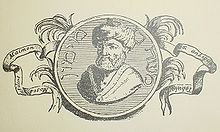
18th-century depiction of Maimonides, who developed the via negativa
Jewish philosopher Maimonides believed that God can only be ascribed negative attributes, a view based on two key Jewish beliefs: that the existence of God must exist accustomed, and that it is forbidden to describe God.[7] Maimonides believed that God is simple and then cannot be ascribed any essential attributes.[viii] He therefore argued that statements about God must be taken negatively, for example, "God lives" should be taken every bit "God does not lack vitality".[9] Maimonides did not believe that God holds all of his attributes perfectly and without harm; rather, he proposed that God lies exterior of any homo measures. To say that God is powerful, for example, would hateful that God'southward power is beyond worldly power, and incomparable to whatsoever other ability. In doing so, Maimonides attempted to illustrate God'southward indescribable nature and draw attention to the linguistic limits of describing God.[10]
Critics maintain that such kind of solution severely limits the degree to which what can be spoken about God.[1]
Analogy and metaphor [edit]
Thomas Aquinas argued that statements about God are analogous to human feel because of the causal human relationship between God and creatures.[1] An analogous term is partly univocal (has just i meaning) and partly equivocal (has more than one potential meaning) considering an illustration is in some ways the same and in some ways different from the subject area.[xi] He proposed that those godly qualities which resemble man qualities are described analogously, with reference to homo terms; for example, when God is described every bit proficient, it does not mean that God is expert in human terms, but that human goodness is used every bit a reference to depict God'south goodness.[1]
Philosopher Taede Smedes argued that religious language is symbolic.[12] Denying any conflict between science and religion, he proposes that 'to believe' means to take a conviction (that God exists, in the context of Christianity), which is unlike from 'knowing', which merely occurs one time something is proven. Thus, according to Smedes, we believe things that nosotros exercise not know for certain.[xiii] Smedes argues that, rather than beingness part of the world, God is so far beyond the globe that there tin be no common standard to which both God and the earth tin can be compared.[14] He argues that people tin still believe in God, even though he cannot be compared to anything in the world, because conventionalities in God is just an alternative way of viewing that globe (he likens this to ii people viewing a painting differently).[fifteen] Smedes claims that at that place should exist no reason to expect for a meaning backside our metaphors and symbols of God because the metaphors are all we have of God. He suggests that nosotros tin can only talk of God pro nobis (for us) and non in se (as such) or sine nobis (without us). The betoken, he argues, is not that our concept of God should stand for with reality, but that we tin but conceive of God through metaphors.[12]
In the twentieth century, Ian Ramsey developed the theory of analogy, a evolution afterward cited in numerous works past Alister McGrath. He argued that various models of God are provided in religious writings that interact with each other: a range of analogies for salvation and the nature of God. Ramsey proposed that the models used modify and qualify each other, defining the limits of other analogies. As a event, no i illustration on its own is sufficient, but the combination of every analogy presented in Scripture gives a full and consistent depiction of God.[xvi] The use of other analogies may then be used to determine if any one model of God is driveling or improperly practical.[17]
It is proposed that illustration is also present in everyday discourses. For example, when a speaker uses the word square, the speakers may well use it to refer to an object that is approximately foursquare rather than a genuine square.[18]
Critics contend that metaphor theories are unsatisfactory because metaphors are always in principle susceptible to literal paraphrase.[xviii]
Symbolism [edit]

Sikh religious text, the Sri Guru Granth Sahib Nishan, in which religious language is used symbolically
Philosopher Paul Tillich argued that religious faith is all-time expressed through symbolism because a symbol points to a meaning beyond itself and best expresses transcendent religious behavior. He believed that whatever statement about God is symbolic and participates in the meaning of a concept.[19] Tillich used the case of a national flag to illustrate his point: a flag points to something beyond itself, the land it represents, only also participates in the pregnant of the state. He believed that symbols could unite a religious believer with a deeper dimension of himself likewise as with a greater reality.[20] Tillich believed that symbols must emerge from an individual collective unconsciousness, and can merely function when they are accepted by the unconscious. He believed that symbols cannot be invented, but alive and dice at the appropriate times.[21]
Louis Dupré differentiates between signs and symbols, proposing that a sign points to something while a symbol represents it. A symbol holds its own significant: rather than simply pointing someone towards some other object, information technology takes the place of and represents that object. He believes that a symbol has some ambiguity which does not exist with a sign.[22] Dupré believes that a symbol may deserve respect considering it contains what is signified within itself.[23] A symbol reveals a reality beyond what is already perceived and transforms the means the current reality is perceived.[24] Dupré differentiates between religious and artful symbols, suggesting that a religious symbol points towards something which "remains forever beyond our accomplish". He proposed that a religious symbol does not reveal the nature of what it signifies, simply conceals it.[25]
Langdon Brown Gilkey explained religious language and experience in terms of symbolism, identifying three feature features of religious symbolism which distinguish it from other language use. Firstly, religious symbolism has a double focus, referring both to something empirical and to something transcendent; Gilkey argued that the empirical manifestation points towards the transcendent beingness. Secondly, he believed that religious symbolism concerns key questions of life, involving issues important to an individual or community. Finally, he argued that religious symbols provide standards by which life should be lived.[26]
In the Sikh religious text the Guru Granth Sahib, religious language is used symbolically and metaphorically. In the text, Sikh Gurus repeat that the experiences they have while meditating are ineffable, incognizable, incomprehensible, and transensuous – this ways that at that place is no object of their feel that tin can be conceptualised.[27] To overcome this, the Sikh Gurus used symbolic and metaphorical language, bold that at that place is a resemblance between the mystical experience of the divine (the sabad) and those experiencing it. For example, light is used to refer to the spiritual reality.[28]
Myth [edit]
William Paden argued that religious language uses myth to present truths through stories. He argued that to those who practice a organized religion, myths are not mere fiction, but provide religious truths. Paden believed that a myth must explain something in the world with reference to a sacred beingness or forcefulness, and dismissed whatsoever myths which did not as "folktales".[29] Using the example of creation myths, he differentiated myths from scientific hypotheses, the latter of which tin can be scientifically verified and do non reveal a greater truth; a myth cannot be analysed in the same fashion as a scientific theory.[29]
Lutheran theologian Rudolf Bultmann proposed that the Bible contains existential content which is expressed through mythology; Bultmann sought to find the existential truths behind the veil of mythology, a task known as 'demythologising'.[thirty] Bultmann distinguished between informative language and linguistic communication with personal import, the latter of which commands obedience. He believed that God interacts with humans equally the divine Discussion, perceiving a linguistic character inherent in God, which seeks to provide humans with cocky-understanding.[31] Bultmann believed that the cultural embeddedness of the Bible could be overcome past demythologising the Bible, a process which he believed would allow readers to amend run across the word of God.[32]
Christian philosopher John Hick believed that the language of the Bible should be demythologised to be compatible with naturalism. He offered a demythologised Christology, arguing that Jesus was not God incarnate, simply a human being with incredible feel of divine reality. To Hick, calling Jesus the Son of God was a metaphor used past Jesus' followers to describe their commitment to what Jesus represented.[33] Hick believed that demythologising the incarnation would make sense of the diversity of world religions and requite them equal validity equally ways to encounter God.[34]
Alternative explanations of religious language [edit]
Political [edit]
Islamic philosopher Carl Ernst has argued that religious language is often political, specially in the public sphere, and that its purpose is to persuade people and establish authorization, likewise as convey information. He explains that the modern criticisms of the W made past some sections of Islam are an ideological reaction to colonialism, which intentionally uses the same language as colonialists.[35] Ernst argues that when it is used rhetorically, religious language cannot be taken at face value considering of its political implications.[36]
Performative [edit]
Peter Donovan argues that most religious language is not nearly making truth-claims; instead, it is used to accomplish certain goals.[37] He notes that linguistic communication can be used in alternative ways beyond making statements of fact, such as expressing feelings or asking questions. Donovan calls many of these uses performative, as they serve to perform a certain function within religious life. For example, the words "I promise" perform the action of promising themselves – Donovan argues that most religious language fulfils this role.[38] Ludwig Wittgenstein too proposed that language could be performative and presented a list of the unlike uses of language. Wittgenstein argued that "the meaning of the language is in the use", taking the utilize of language to be performative.[39] The philosopher J. L. Austin argued that religious language is non just cognitive but can perform social acts, including vows, blessings, and the naming of children.[40] He distinguished performative statements every bit those that practise not merely describe a situation, simply bring them near.[41] Historian of religion Benjamin Ray uses the performance of rituals within religions as evidence for a performative interpretation of language. He argues that the language of rituals tin perform social tasks: when a priest announces that a spiritual event has occurred, those nowadays believe it considering of the spiritual authorization of the priest. He believed that the meaning of a ritual is divers past the language used by the speaker, who is defined culturally as a superhuman agent.[42]
Imperative [edit]
British philosopher R. B. Braithwaite attempted to arroyo religious language empirically and adopted Wittgenstein's idea of "significant as use".[43] He likened religious statements to moral statements considering they are both non-descriptive even so all the same take a utilise and a meaning; they do not draw the world, but the believer's attitudes towards it. Braithwaite believed that the primary difference between a religious and a moral argument was that religious statements are part of a linguistic system of stories, metaphors, and parables.[44]
Professor Nathan Katz writes of the illustration of a burning building, used by the Buddha in the Lotus Sutra, which casts religious language as imperative. In the analogy, a father sees his children at the top of a burning building. He persuades them to leave, but only by promising them toys if they leave. Katz argues that the bulletin of the parable is not that the Buddha has been telling lies; rather, he believes that the Buddha was illustrating the imperative apply of linguistic communication. Katz believes that religious linguistic communication is an imperative and an invitation, rather than a truth-merits.[45]
Challenges to religious language [edit]
David Hume [edit]
In the conclusion of his Enquiry Concerning Human Understanding, Scottish philosopher David Hume argued that statements that make claims about reality must exist verified by experience, and dismissed those that cannot exist verified as meaningless. Hume regarded most religious language as unverifiable past experiment and and then dismissed it.[46]
Does it contain whatsoever abstract reasoning apropos quantity or number? No. Does it incorporate whatsoever experimental reasoning apropos matter of fact of existence? No. Commit it then to the flames: for it can incorporate nothing but sophistry and illusion.
—David Hume, Inquiry Concerning Human Understanding [46]
Hume criticised the view that we cannot speak about God, and proposed that this view is no different from the skeptical view that God cannot exist spoken near. He was unconvinced by Aquinas' theory of illustration and argued that God's attributes must be completely different from human being attributes, making comparisons between the ii impossible. Hume's scepticism influenced the logical positivist movement of the twentieth century.[47]
Logical positivism [edit]
The logical positivism movement originated in the Vienna Circumvolve and was connected by British philosopher A. J. Ayer. The Vienna Circle adopted the distinction between analytic and constructed statements: analytic statements are those whose meaning is independent within the words themselves, such as definitions, tautologies or mathematical statements, while synthetic statements make claims about reality.[48] To determine whether a synthetic statement is meaningful, the Vienna Circumvolve adult a verifiability theory of meaning, which proposed that for a constructed argument to have cerebral significant, its truthfulness must be empirically verifiable.[49] Considering claims well-nigh God cannot exist empirically verified, the logical positivists argued that religious propositions are meaningless.[48]
In 1936, Ayer wrote Language, Truth and Logic, in which he claimed that religious language is meaningless.[50] He put forward a strong empirical position, arguing that all knowledge must either come from observations of the globe or be necessarily true, like mathematical statements.[51] In doing so, he rejected metaphysics, which considers the reality of a world across the natural world and science. Because it is based on metaphysics and is therefore unverifiable, Ayer denounced religious language, as well as statements about ethics or aesthetics, as meaningless.[52] Ayer challenged the meaningfulness of all statements about God – theistic, atheistic and agnostic – arguing that they are all equally meaningless considering they all talk over the beingness of a metaphysical, unverifiable being.[48]
Austrian philosopher Ludwig Wittgenstein finished his Tractatus Logico-Philosophicus with the proposition that "Whereof one cannot speak, thereof 1 must be silent." Beverly and Brian Ballyhoo have suggested that because of this statement, Wittgenstein was taken for a positivist by many of his disciples because he made a distinction between what can and cannot exist spoken about. They argue that this interpretation is inaccurate considering Wittgenstein held the mystical, which cannot be described, every bit important.[53] Rather than dismissing the mystical as meaningless, as the logical positivists did, Wittgenstein believed that while the facts of the world remain the same, the perspective from which they are viewed will vary.[54]
Falsification [edit]
The falsification principle has been developed as an alternative theory past which it may be possible to distinguish betwixt those religious statements that may potentially have pregnant, and those that are meaningless. It proposes that most religious language is unfalsifiable because there is no way that it could be empirically proven false. In a landmark newspaper published in 1945, analytic philosopher Antony Flew argued that a meaningful argument must simultaneously assert and deny a situation; for example, the statement "God loves us" both asserts that God loves us and denies that God does non love u.s.. Flew maintained that if a religious believer could not say what circumstances would have to be for their statements virtually God to be false, and then they are unfalsifiable and meaningless.[51]
Using John Wisdom'south parable of the invisible gardener, Flew attempted to demonstrate that religious language is unfalsifiable. The parable tells the story of two people who notice a garden on a deserted isle; one believes information technology is tended to by a gardener, the other believes that it formed naturally, without the existence of a gardener. The two picket out for the gardener but never find him; the non-laic consequently maintains that there is no gardener, whereas the believer rationalises the non-appearance past suggesting that the gardener is invisible and cannot be detected.[55] Flew contended that if the laic's estimation is accepted, zippo is left of the original gardener. He argued that religious believers tend to adopt counterpart rationalisations in response to any apparent claiming to their beliefs from empirical evidence; and these beliefs consequently suffer a "decease past a one thousand qualifications" every bit they are qualified and modified so much that they end upwards asserting goose egg meaningful.[56] Flew applied his principles to religious claims such as God's love for humans, arguing that if they are meaningful assertions they would deny a certain country of affairs. He argued that when faced with evidence against the existence of a loving God, such every bit the terminal illness of a kid, theists volition qualify their claims to let for such evidence; for example they may suggest that God's love is unlike from human love. Such qualifications, Flew argued, make the original proposition meaningless; he questioned what God'due south honey actually promises and what information technology guarantees against, and proposed that God's qualified love promises nothing and becomes worthless.[57]
Flew continued in many subsequent publications to maintain the falsifiability criterion for meaning; but in later life retracted the specific assertion in his 1945 newspaper that all religious language is unfalsifiable, and so meaningless. Drawing specifically on the emerging science of molecular genetics (which had non existed at the time of his original paper), Flew eventually became convinced that the complexity this revealed in the mechanisms of biological reproduction might not be consistent with the time known to take been bachelor for development on Earth to have happened; and that this potentially suggested a valid empirical test by which the assertion "that there is no creator God" might be falsified; "the latest work I take seen shows that the present concrete universe gives besides footling time for these theories of abiogenesis to get the task done."[58]
Analogies of games [edit]
The analogy of a game was outset proposed by Hans-Georg Gadamer in an attempt to demonstrate the epistemic unity of linguistic communication. He suggested that language is like a game which anybody participates in and is played by a greater being.[59] Gadamer believed that language makes up the primal construction of reality and that homo language participates in a greater language; Christianity teaches this to be the divine give-and-take which created the earth and was incarnate in Jesus Christ.[threescore]
Ludwig Wittgenstein proposed a calculus theory of language, which maintained that all language should be analysable in a uniform fashion. Later in his life he rejected this theory, and instead proposed an culling language-game analogy.[61] He likened the differences in languages to the differences in games, arguing that simply as there are many different games, each with different rules, so in that location are many different kinds of language.[62] Wittgenstein argued that different forms of language accept unlike rules which determine what makes a proposition meaningful; outside of its language-game, a proposition is meaningless. He believed that the meaning of a proposition depends on its context and the rules of that context.[63] Wittgenstein presented a linguistic communication game as a situation in which certain kinds of language are used. He provided some examples of language games: "Request, thanking, greeting, cursing, praying".[64]
It is as if someone were to say: 'A game consists of moving objects about on a surface according to certain rules...' – and we replied: You lot seem to be thinking of board games, just at that place are others.
Wittgenstein believed that faith is significant because information technology offers a particular manner of life, rather than confirming the existence of God. He therefore believed that religious language is confessional – a confession of what someone feels and believes – rather than consisting of claims to truth. Wittgenstein believed that religious language is different from language used to describe physical objects because it occupies a different language game.[65]
Dewi Zephaniah Phillips dedicated Wittgenstein's theory by arguing that although religious language games are autonomous, they should not be treated as isolated because they brand statements about secular events such equally birth and expiry. Phillips argued that because of this connectedness, religions tin nevertheless exist criticised based on human experiences of these secular events. He maintained that religion cannot be denounced as incorrect considering it is not empirical.[66]
Peter Donovan criticises the language-games arroyo for failing to recognise that religions operate in a globe containing other ideas and that many religious people make claims to truth. He notes that many religious believers non only believe their organized religion to exist meaningful and true in its own context, but claim that it is true against all other possible behavior; if the language games analogy is accepted, such a comparison between beliefs is incommunicable.[67] Donovan proposes that debates between unlike religions, and the apologetics of some, demonstrates that they interact with each other and the wider globe and so cannot exist treated as isolated language games.[68]
Parables [edit]
R. Chiliad. Hare [edit]
In response to Flew's falsification principle, British philosopher R. 1000. Hare told a parable in an try to demonstrate that religious language is meaningful. Hare described a lunatic who believes that all university professors want to impale him; no amount of evidence of kindly professors will dissuade him from this view. Hare called this kind of unfalsifiable conviction a "blik", and argued that it formed an unfalsifiable, still still meaningful, worldview. He proposed that all people – religious and not-religious – hold bliks, and that they cannot be unseated by empirical evidence. Nevertheless, he maintained that a blik is meaningful because it forms the ground of a person'due south understanding of the world.[69] Hare believed that some bliks are correct and others are not, though he did non propose a method of distinguishing between the two.[seventy]
Basil Mitchell [edit]
Basil Mitchell responded to Flew's falsification principle with his own parable. He described an underground resistance soldier who meets a stranger who claims to be leading the resistance motion. The stranger tells the soldier to continue faith in him, even if he is seen to be fighting for the other side. The soldier's faith is regularly tested every bit he observes the stranger fighting for both sides, just his religion remains potent.[71] Mitchell's parable teaches that although testify can challenge a religious belief, a believer yet has reason to agree their views.[72] He argued that although a believer will not permit annihilation to count decisively against his beliefs, the theist still accepts the beingness of evidence which could count against religious belief.[73]
John Hick [edit]
Responding to the verification principle, John Hick used his parable of the Celestial Urban center to describe his theory of eschatological verificationism. His parable is of ii travellers, a theist and an atheist, together on a route. The theist believes that there is a Celestial Metropolis at the terminate of the road; the atheist believes that in that location is no such urban center. Hick's parable is an allegory of the Christian conventionalities in an afterlife, which he argued can be verified upon decease.[74] Hick believed that eschatological verification is "unsymmetrical" because while it could exist verified if it is true, it cannot be falsified if not. This is in contrast to ordinary "symmetrical" statements, which can exist verified or falsified.[75]
In his biography of Hick, David Cheetham notes a criticism of Hick'southward theory: waiting for eschatological verification could make religious conventionalities provisional, preventing total commitment to faith.[76] Cheetham argues that such criticism is misapplied because Hick's theory was not directed to religious believers but to philosophers, who argued that religion is unverifiable and therefore meaningless.[76]
James Morris notes that Hick'south eschatological verification theory has been criticised for beingness inconsistent with his conventionalities in religious pluralism. Morris argues that such criticism can be overcome by modifying Hick'southward parable to include multiple travellers, all with unlike behavior, on the road. He argues that fifty-fifty if some beliefs well-nigh life after death are unverifiable, Hick's conventionalities in bodily resurrection tin notwithstanding be verified.[73]
Come across also [edit]
- Theological noncognitivism
- Divine simplicity
- Apophatic theology
- Ineffability
Notes [edit]
- ^ a b c d east Weed 2007.
- ^ Davies 2004, p. 139–140.
- ^ White 2010, p. i.
- ^ McFague 1982, p. 1.
- ^ White 2010, p. 1–two.
- ^ McFague 1982, p. i–ii.
- ^ Levin & Schweid 2008, p. 237.
- ^ Hyman 2008, p. 400.
- ^ Seeskin 2005, p. 88.
- ^ Seeskin 2005, p. 89.
- ^ Cahalan 1985, p. 438.
- ^ a b Depoortere, van Erp & Boeve 2010, p. 44.
- ^ Depoortere, van Erp & Boeve 2010, p. 41.
- ^ Depoortere, van Erp & Boeve 2010, p. 43.
- ^ Depoortere, van Erp & Boeve 2010, p. 45-46.
- ^ McGrath 2011, ch. 13.
- ^ McGrath 1998, p. 183.
- ^ a b Scott 2017.
- ^ Cooper 1997, p. 134.
- ^ Dourley 1975, p. 85–half-dozen.
- ^ Rees 2001, p. 80.
- ^ Dupré 2000, p. one.
- ^ Dupré 2000, p. 1–2.
- ^ Dupré 2000, p. two.
- ^ Dupré 2000, p. 6.
- ^ Pasewark & Puddle 1999, p. 103.
- ^ Singh 1990, p. 185.
- ^ Singh 1990, p. 186.
- ^ a b Paden 1994, p. 73–74.
- ^ Sherratt 2006, p. 81.
- ^ Sherratt 2006, p. 82.
- ^ Dray 2002, p. 259.
- ^ Mbogu 2008, p. 117.
- ^ Hebblethwaite 1987, p. 7.
- ^ Ernst 2004, p. viii.
- ^ Ernst 2004, p. 9.
- ^ Donovan 1982, p. 78.
- ^ Donovan 1982, p. 79–80.
- ^ Robinson 2003, p. 29.
- ^ Hoffman 2007, p. 26.
- ^ Lawson & McCauley 1993, p. 51.
- ^ Lawson & McCauley 1993, p. 51–ii.
- ^ Harris 2002, p. 49.
- ^ Tracy 1996, p. 121.
- ^ Katz 1982, p. 232.
- ^ a b Clack & Ballyhoo 2008, p. 98.
- ^ Jones 2006, p. 171–2.
- ^ a b c Evans 1985, p. 142.
- ^ Weinberg 2001, p. 1.
- ^ Attfield 2006, p. eleven.
- ^ a b Tracy 1996, p. 120.
- ^ Oppy & Scott 2010, p. 8.
- ^ Clack & Clack 1998, p. 110.
- ^ Clack & Clack 1998, p. 111.
- ^ Lumsden 2009, p. 44.
- ^ Jones 2006, p. 172.
- ^ Allen 1992, p. 283–284.
- ^ Flew 2007, p. 124.
- ^ Horn 2005, p. 111.
- ^ Cooper 2006, p. 217–218.
- ^ Labron 2006, p. 28.
- ^ a b Horn 2005, p. 112.
- ^ Glock 1996, p. 192–193.
- ^ Brenner 1999, p. sixteen.
- ^ Clack 1999, p. 79.
- ^ Lacewing & Pascal 2007, p. 173–4.
- ^ Donovan 1982, p. 93.
- ^ Donovan 1982, p. 94–95.
- ^ Jones 2006, p. 173.
- ^ Harris 2002, p. 37–38.
- ^ Clarke 2001, p. 148.
- ^ Griffiths & Taliaferro 2003, p. 108–109.
- ^ a b Harris 2002, p. 64.
- ^ Polkinghorne 2003, p. 145–146.
- ^ Cheetham 2003, p. 39.
- ^ a b Cheetham 2003, p. 30.
Bibliography [edit]
- Allen, Diogenes (1992). Primary Readings in Philosophy for Agreement Theology. Westminster John Knox Press. ISBN978-0-664-25208-3.
- Attfield, Robin (2006). Creation, evolution and meaning. Ashgate Publishing. ISBN978-0-7546-0475-4.
- Bowie, Robert (2002). Philosophy of Religion & Religious Ethics: Study. Nelson Thornes. ISBN978-0-7487-8081-v.
- Brenner, Williams (1999). Wittgenstein's philosophical investigations. Country University of New York Press. ISBN978-0-7914-4202-9.
- Bunnin, Nicholas; Tsui-James, Eastward. P. (2003). The Blackwell Companion to Philosophy. John Wiley & Sons. ISBN0-631-21908-0.
- Cahalan, John (1985). Causal realism: an essay on philosophical method and the foundations of noesis. John C. Cahalan. ISBN978-0-8191-4622-9.
- Cheetham, David (2003). John Hick: a disquisitional introduction and reflection. Ashgate Publishing. ISBN978-0-7546-1599-6.
- Clack, Brian (1999). An introduction to Wittgenstein's philosophy of religion. Edinburgh Academy Press. ISBN978-0-7486-0939-0.
- Clack, Brian; Ballyhoo, Beverley (1998). The philosophy of religion: a critical introduction . Wiley-Blackwell. ISBN978-0-7456-1738-1.
- Clack, Brian; Clack, Beverley (2008). Philosophy of Organized religion. Polity. ISBN978-0-7456-3868-iii.
- Clarke, P. J. (2001). Questions About God: A Guide for Students. Nelson Thornes. ISBN978-0-7487-6554-half dozen.
- Cooper, John Charles (1997). The 'spiritual presence' in the theology of Paul Tillich: Tillich's use of St. Paul. Mercer University Press. ISBN978-0-86554-535-ix.
- Cooper, John W. (2006). Panentheism, the Other God of the Philosophers: From Plato to the Nowadays. Baker Academic. ISBN978-0-8010-2724-half dozen.
- Depoortere, Frederiek; van Erp, Stephan; Boeve, Lieven (2010). Edward Schillebeeckx and Gimmicky Theology. Continuum International Publishing Group. ISBN978-0-567-18160-2.
- Davies, Brian (2004). An Introduction to the Philosophy of Religious Language. Oxford Academy Press. ISBN978-0-nineteen-926347-9.
- Donovan, Peter (1982). Religious Linguistic communication. Sheldon Press. ISBN0-85969-054-7.
- Dourley, John (1975). Paul Tillich and Bonaventure: An Evaluation of Tillich's Merits to Stand in the Augustinian-Franciscan Tradition . Brill Archive. ISBN978-90-04-04266-7.
- Dray, Stephen P. (2002). From Consensus to Anarchy: An Historical Analysis of Evangelical Interpretation of 1 Timothy 2:viii–fifteen from 1945–2001. Universal-Publishers. ISBN9781581123500.
- Dupré, Louis (2000). Symbols of the Sacred. Wm. B. Eerdmans Publishing. ISBN978-0-8028-4748-v.
- Ernst, Carl (2004). Following Muhammad: Rethinking Islam in the Contemporary World. University of North Carolina Press. ISBN978-0-8078-5577-5.
- Evans, C. Stephen (1985). Philosophy of religion: thinking nearly faith. InterVarsity Press. ISBN978-0-87784-343-6.
- Flew, Antony (2007). There is a God: How the World'south Most Notorious Atheist Changed His Mind. New York: Harper One.
- Glock, Hans-Johann (1996). A Wittgenstein dictionary. Wiley-Blackwell. ISBN978-0-631-18537-half-dozen.
- Griffiths, Paul; Taliaferro, Charles (2003). Philosophy of faith: an album. Wiley-Blackwell. ISBN978-0-631-21471-7.
- Harris, James Franklin (2002). Analytic philosophy of faith. Springer. ISBN978-i-4020-0530-5.
- Hebblethwaite, Brian (1987). The Incarnation: Collected Essays in Christology. Cambridge University Printing. ISBN978-0-521-33640-half-dozen.
- Hoffman, Thomas (2007). The Poetic Qurʼān: Studies on Qurʼānic Poeticity. Otto Harrassowitz Verlag. ISBN978-3-447-05515-4.
- Horn, Patrick Rogers (2005). Gadamer and Wittgenstein on the unity of language: reality and discourse without metaphysics. Ashgate Publishing. ISBN978-0-7546-0969-8.
- Hyman, Arthur (2008). Maimonidean studies, Volume v. KTAV Publishing Business firm. ISBN978-0-88125-941-iv.
- Jones, Michael (2006). The metaphysics of organized religion: Lucian Blaga and gimmicky philosophy. Fairleigh Dickinson Univ Press. ISBN978-0-8386-4100-ii.
- Katz, Nathan (1982). Buddhist Images of Homo Perfection: The Arahant of the Sutta Piṭaka Compared with the Bodhisattva and the Mahāsiddha. Motilal Banarsidass. ISBN978-81-208-0647-4.
- Labron, Tim (2006). Wittgenstein's Religious Signal of View. Continuum International Publishing Group. ISBN978-0-8264-9027-8.
- Lacewing, Michael; Pascal, Jean-Marc (2007). Revise Philosophy for As Level. Taylor & Francis. ISBN978-0-415-39997-five.
- Lawson, E. Thomas; McCauley, Robert (1993). Rethinking Religion: Connecting Cognition and Civilisation. Cambridge University Press. ISBN978-0-521-43806-3.
- Levin, Leonard; Schweid, Eliezer (2008). The classic Jewish philosophers: from Saadia through the Renaissance. Brill Publishers. ISBN978-xc-04-16213-6.
- Lumsden, Robert (2009). Reading literature after deconstruction. Cambria Press. ISBN978-1-60497-526-0.
- Mbogu, Nicholas Ibeawuchi (2008). Christology and Religious Pluralism: A Review of John Hick's Theocentric Model of Christology and the Emergence of African Inculturation Christologies. LIT Verlag Münster. ISBN978-iii-8258-9942-4.
- McFague, Sallie (1982). Metaphorical Theology: Models of God in Religious Linguistic communication. Fortress Printing. ISBN978-0-8006-1687-8.
- McGrath, Alister (1998). The foundations of dialogue in science and religion. Wiley-Blackwell. ISBN978-0-631-20854-9.
- McGrath, Aliser (2011). Science and Religion: A New Introduction. John Wiley & Sons. ISBN978-ane-4443-5808-vii.
- Oppy, Graham; Scott, Michael (2010). Reading Philosophy of Religion. John Wiley & Sons. ISBN978-1-4051-7082-6.
- Paden, William (1994). Religious Worlds: The Comparative Study of Faith. Beacon Press. ISBN978-0-8070-1229-1.
- Pasewark, Kyle; Pool, Jeff (1999). The theology of Langdon B. Gilkey: systematic and critical studies. Mercer University Printing. ISBN978-0-86554-643-1.
- Polkinghorne, John (2003). The God of Promise and the Stop of the World. Yale University Press. ISBN978-0-300-09855-6.
- Rees, Frank (2001). Wrestling With Doubt: Theological Reflections on the Journeying of Faith. Liturgical Printing. ISBN978-0-8146-2590-3.
- Robinson, Douglas (2003). Performative Linguistics: Speaking and Translating Every bit Doing Things With Words. Psychology Printing. ISBN978-0-415-30036-0.
- Rocca, Gregory (2004). Speaking the Incomprehensible God: Thomas Aquinas on the Interplay of Positive and Negative Theology. Catholic University of America Press. ISBN978-0-8132-1367-5.
- Scott, Michael (2017). "Religious Language". In Zalta, Edward Northward. (ed.). The Stanford Encyclopedia of Philosophy (Winter 2017 Edition) . Retrieved March 27, 2021.
- Seeskin, Kenneth (2005). The Cambridge companion to Maimonides. Cambridge Academy Printing. ISBN978-0-521-81974-9.
- Sherratt, Yvonne (2006). Continental Philosophy of Social Science: Hermeneutics, Genealogy and Critical Theory from Ancient Greece to the Twenty-start Century. Cambridge Academy Printing. ISBN978-0-521-85469-half-dozen.
- Singh, Nirbhai (1990). Philosophy of Sikhism: Reality and Its Manifestations . Atlantic Publishers & Distri. ISBN978-99906-602-three-4.
- Tracy, David (1996). Blessed rage for guild: the new pluralism in theology : with a new preface. University of Chicago Printing. ISBN978-0-226-81129-i.
- Weed, Jennifer Hart (Feb 19, 2007). "Religious Language". In Fieser, James; Dowden, Bradley (eds.). Cyberspace Encyclopedia of Philosophy. ISSN 2161-0002. Retrieved February 16, 2012.
- Weinberg, Julius (2001). An Test of Logical Positivism, Volume eight. Routledge. ISBN978-0-415-22549-6.
- White, Roger (2010). Talking well-nigh God: the concept of analogy and the problem of religious language. Ashgate Publishing. ISBN978-i-4094-0036-3.
External links [edit]
- Problem of religious language at the Indiana Philosophy Ontology Projection
- Problem of religious language at PhilPapers
- "Trouble of religious language". Internet Encyclopedia of Philosophy.
Source: https://en.wikipedia.org/wiki/Problem_of_religious_language
0 Response to "what is the problem of religious language and how did erigena attempt to solve it?"
Post a Comment